A line array looks like a serious PA.
It hangs from truss. It appears on festival stages. It photographs well. Clients recognise it as “the big system.”
That has created one of the worst purchasing habits in live sound: choosing a line array because it looks more professional, even when a pair of properly selected point-source speakers would cover the venue better.
The reverse mistake happens too. An event company keeps scaling a point-source rig by stacking more boxes until a long venue becomes a fight between level at the front, intelligibility at the back and reflections everywhere else.
Neither technology wins automatically.
The correct question is:
What coverage pattern, throw distance, output and deployment geometry does this event require?
The short answer
Use point-source systems when you want simple deployment, coherent coverage from relatively few cabinets, short-to-medium throw and flexibility.
Use line-array or line-source systems when you need controlled vertical coverage, longer audience depth, scalable output and the ability to shape level distribution across a large seating/standing area.
But there are important exceptions, and modern loudspeaker designs blur the categories.
A good point-source system can cover surprisingly large events. A badly designed or undersized line array can be terrible.
What is a point-source speaker?
A point-source loudspeaker is designed to behave approximately like one acoustic source over its intended operating range.
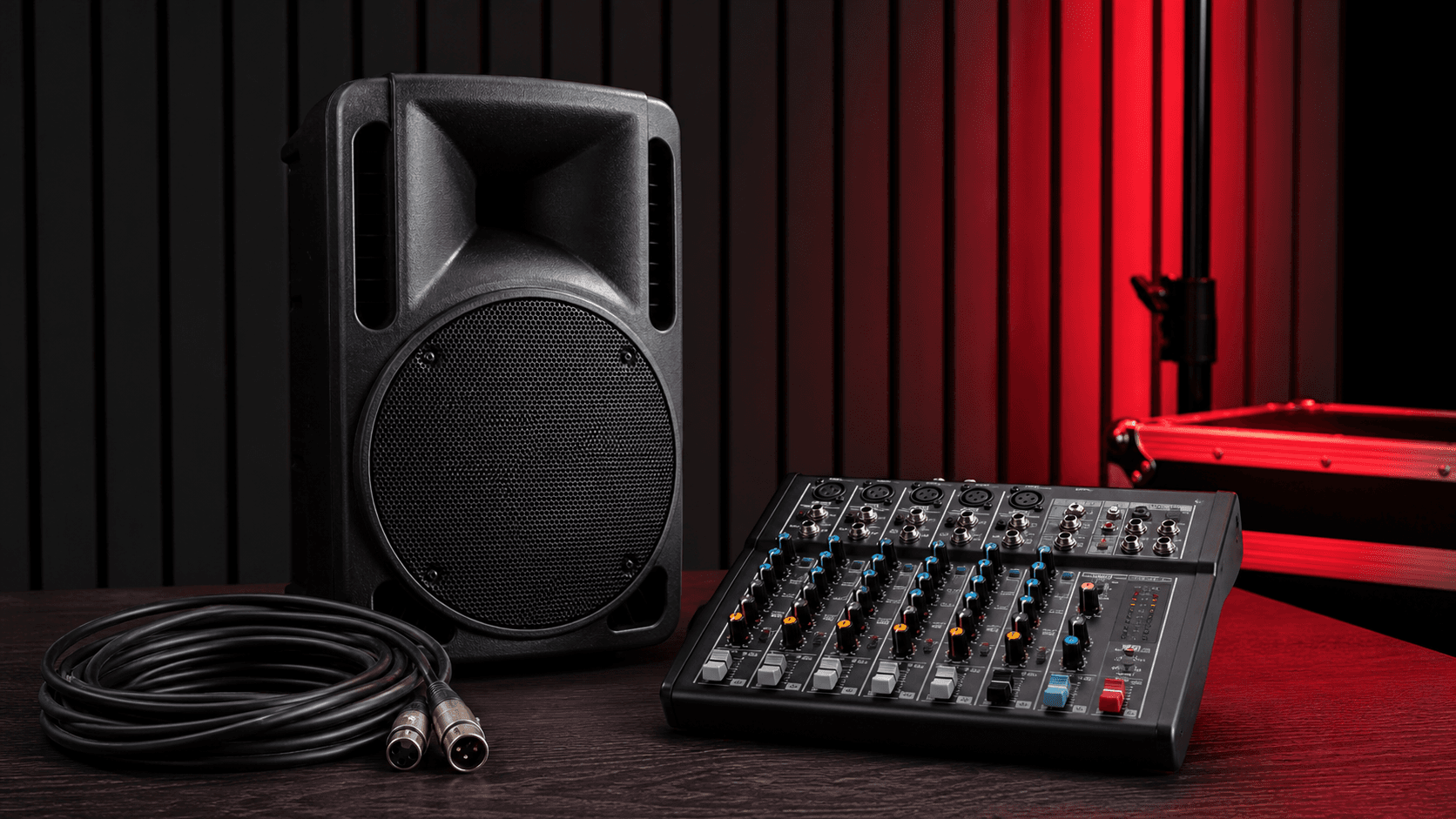
Most portable PA cabinets fall into this family: a woofer/mid driver plus a horn or coaxial high-frequency section, with a defined horizontal and vertical dispersion.
Typical applications include:
- Portable DJ systems
- Small-to-medium live events
- Churches
- Corporate AV
- Stage fills
- Front fills
- Delay speakers
- Monitors
- Installed venue systems
The important concept is defined coverage.
A speaker might be designed for 90° horizontal × 60° vertical coverage, 75° conical coverage, or a narrower high-directivity pattern.
That tells you where the acoustic energy is intended to go.
What is a line array?
A line array is built from multiple loudspeaker elements arranged vertically so that they acoustically couple over part of their operating range.
The purpose is not merely to “add more speakers.”
The array gives the system designer control over vertical directivity and level distribution by changing:
- Number of cabinets
- Array length
- Splay angles between elements
- Hang height
- Curvature
- DSP shading in some systems
A long, relatively straight section can project energy toward distant listeners. A more curved lower section can cover listeners closer to the stage.
That is the real value of an array: you can shape the vertical coverage to match the audience geometry.
The myth: line arrays only lose 3 dB per distance doubling
You will often hear this simplified claim:
Point source = 6 dB loss per doubling of distance. Line array = 3 dB.
That is not a reliable way to design a real PA.
An ideal infinite line source in a theoretical region behaves differently from a point source, but a real line array has finite length, frequency-dependent coupling and a transition between behaviours.
At some frequencies and distances it can approximate line-source behaviour. At others it behaves more like a conventional source.
What matters in practice is the manufacturer's acoustic model, array length, frequency range, cabinet spacing, splay and audience geometry.
Do not buy a line array based on a slogan about “3 dB.”
Where line arrays are genuinely strong
1. Long audience areas
A deep audience creates a level-distribution problem.
If the main speaker is near the stage and the back row is four times farther away than the front row, the natural level difference can be substantial.
Turning the system up to satisfy the back can make the front uncomfortable.
A line array can be configured so that different parts of the array contribute differently to near and far audience zones.
That is difficult to achieve with one conventional point-source box.
2. Vertical directivity control
In many venues the biggest enemy is not lack of output — it is sound going where you do not want it.
Examples:
- High church ceilings
- Reflective rear walls
- Stadium roofs
- Balcony fronts
- Glass architecture
A correctly designed array can reduce wasted vertical energy and keep more of the system on the audience.
That can improve intelligibility dramatically.
3. Scalable output
Need more output and longer throw? Add more elements within the system's approved design limits and recalculate the array.
The important word is recalculate.
Adding cabinets changes array behaviour. It is not simply a louder version of the same hang.
4. Consistent tonal balance over distance
A properly designed array can maintain more consistent frequency balance across a large audience because the system's directivity is controlled over a wider frequency range than many small point-source boxes.
This is one reason line arrays dominate large touring systems.
Where point-source systems are better
1. Small and medium rooms
A line array needs physical length to control lower frequencies effectively.
Hang a tiny array of two or three small boxes in a low-ceiling room and you may gain very little compared with one well-designed high-output point source.
Worse, you add:
- Rigging complexity
- More amplifier/DSP channels
- More cabling
- More setup time
- More alignment variables
For a 150-person room, simplicity can sound better.
2. Wide, shallow audiences
If the audience is 20 metres wide but only eight metres deep, long-throw vertical control is not the main problem.
You need horizontal coverage.
A point-source system with appropriate horizontal dispersion — possibly multiple discrete zones — may be much easier to deploy.
3. Venues where you cannot fly the system
Line arrays are usually at their best when properly flown at the correct height and angle.
Ground-stacking is possible with many systems, but the geometry and sightlines may be compromised.
If the venue has no certified rigging points and you are forced to build a low stack, a high-output point-source system may deliver better coverage with less risk.
4. Fast mobile events
For wedding and corporate production, setup time matters.
Two point-source tops on stands or poles plus subs can be deployed quickly by a small crew.
A flown array requires rigging hardware, motors or lifting systems, safety procedures and qualified people.
Use the complexity when the acoustic requirement justifies it.
The hidden variable: horizontal coverage
Line arrays primarily give you control in the vertical plane.
Horizontal coverage is still largely determined by the individual cabinet or waveguide design.
If each box is 90° horizontal and you hang eight of them, you do not suddenly have an 8 × 90° horizontal array.
They are vertically arranged.
This matters when the audience wraps around a stage, fills side seating or occupies a very wide room.
You may need:
- Main left/right arrays
- Outfills
- Side fills
- Front fills
- Delays
No single speaker type magically covers every seat.
Why cheap mini line arrays often disappoint
There are excellent compact array and column products on the market.
There are also products that look like line arrays but do not have enough physical aperture, driver spacing, waveguide control or output to behave like the systems people are imagining when they hear “line array.”
A short array can still be useful. Just understand its job.
Small line-source/column systems are often excellent for:
- Speech
- Houses of worship
- Corporate events
- Acoustic music
- Difficult reverberant spaces
They can provide controlled vertical dispersion and elegant physical form.
But they are not automatically a substitute for a large-format festival array.
What about column arrays?
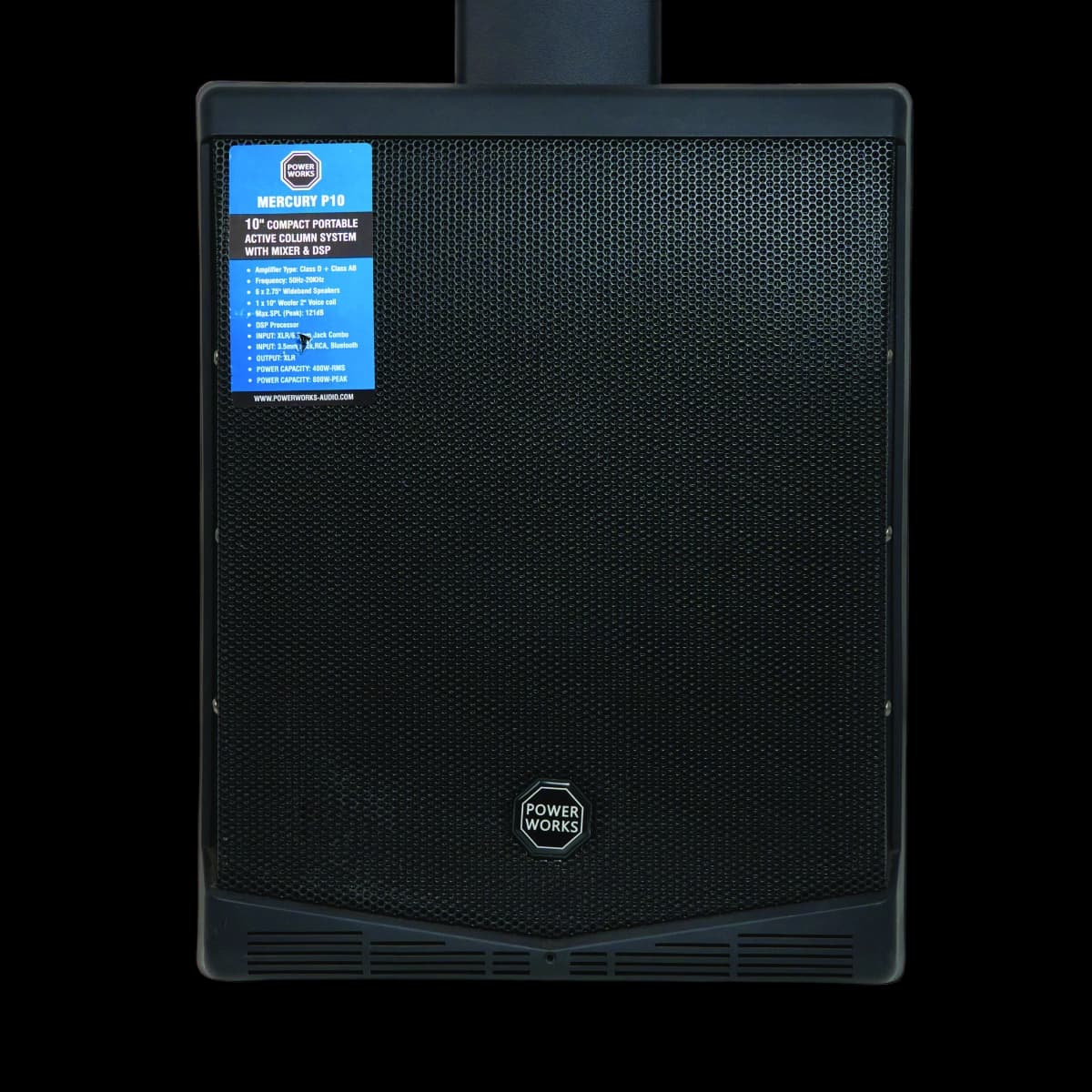
Column loudspeakers use multiple small drivers in a tall vertical arrangement.
Their strength is often narrow vertical dispersion with wider horizontal coverage, which helps keep energy off floors and ceilings in reverberant rooms.
Modern powered columns may also include beam steering or DSP control.
For churches, restaurants, transport spaces and speech-heavy venues, columns can outperform conventional boxes because they solve a coverage problem, not because they are louder.
A practical comparison
Point source
Strengths
- Simple deployment
- Lower rigging complexity
- Excellent transient coherence from one cabinet
- Cost-effective for small/medium venues
- Easy to use as fills or delays
- Broad product range
Weaknesses
- Level falls quickly over long audience depth
- Vertical coverage is fixed by cabinet design
- Scaling by adding overlapping boxes can create interference
- Large rooms may require delays/distribution
Line array / line source
Strengths
- Shapeable vertical coverage
- Better control over long audience depth
- Scalable output
- Good directivity over a wider frequency range when properly designed
- Can reduce energy on ceilings/rear walls
Weaknesses
- More expensive
- More amplifier/DSP channels
- Rigging and safety requirements
- Requires prediction and setup knowledge
- Small arrays can be misapplied
- Poorly configured arrays sound worse than good point source
Church example: 400-seat long sanctuary
Imagine a 30-metre-long sanctuary with a high reflective ceiling.
The stage is at one end.
A pair of wide-dispersion point-source boxes can certainly make enough SPL. But to reach the rear seats, the front rows may be excessively loud, and energy hitting the ceiling/rear wall can reduce speech clarity.
Options include:
- Higher-directivity point sources plus delayed fills
- Compact line-source/array system designed to cover front-to-back
- Distributed installed loudspeakers with DSP delays
The best solution depends on architecture and aesthetics.
Notice that “how many watts?” is not even the important question.
Wedding/event example: 180 guests in a ballroom
A pair of quality point-source tops with subs is usually the sensible solution.
Why?
- Audience depth is moderate
- Setup is temporary
- Rigging may not be available
- Deployment needs to be fast
- Dancefloor is usually localised
A line array may look impressive but add cost and setup complexity without improving the actual result.
Outdoor event example: 1,500 people
Now the situation changes.
The audience is deep. There is little room reflection to support the system. Wind and atmospheric conditions affect high-frequency propagation. The front-to-back level difference becomes significant.
This is where a properly modelled line array or large-format directional system earns its place.
You may also need:
- Front fills
- Outfills
- Sub arrays
- Delay towers
- System processing/networking
At this scale, system design should be based on prediction software and venue geometry.
Subs are a separate decision
Do not assume the main speaker format determines the subwoofer layout.
Line arrays are normally paired with dedicated sub systems, and the sub array has its own acoustic design problem.
Choices include:
- Left/right stacks
- Centre cluster
- End-fire
- Gradient/cardioid
- Distributed sub arrays
Low frequencies are far less directional than high frequencies, so physical placement and timing become critical if you want bass where the audience is and less bass on stage or outside the venue.
Rigging is not optional engineering
If you are flying loudspeakers above people, the conversation changes immediately.
You need:
- Manufacturer-approved rigging hardware
- Correct frames/pins
- Known load limits
- Certified suspension points
- Appropriate motors/hoists
- Secondary safety where required
- Competent rigging personnel
Do not improvise line-array suspension from generic hardware because “it fits.”
A line array that is acoustically perfect and mechanically unsafe is not a professional system.
Current NXT examples
NXT carries both categories because they solve different jobs.
Portable point-source products appear throughout our live-sound catalogue and rental packages, including powered full-range speakers such as JBL EON-series systems and passive designs from multiple professional brands.
At the line-source end, products such as the Celto Acoustique Isoray 10+ / CCA10 are designed around compact line-source behaviour, high SPL-to-size ratio and controlled deployment rather than the conventional “one big woofer and horn” format.
The existence of both product types is the point: there is no universal winner.
The buying question to ask
Do not ask:
“Is line array better?”
Ask:
“What coverage problem am I solving?”
Then answer:
- How wide is the audience?
- How deep is the audience?
- What is the highest/lowest listener position?
- Can the system be flown?
- How reflective is the venue?
- What SPL is required?
- Speech, live band or dance music?
- Temporary or permanent?
- How much setup time and crew do we have?
- Do we need front fills/delays/outfills?
Once those answers exist, the correct loudspeaker architecture becomes much easier to see.
Choosing between point source, column or line-array systems? Send NXT Level Tech your venue dimensions, audience layout and event type. We can help map the coverage requirement first, then specify the hardware around it. Browse Line Array & Column Speakers, or talk to us about a system design.