Watts Won't Tell You How Loud It Is
Watts is the number printed biggest on the box, and it's the least useful one when you're sizing a PA for a hall. Here's the method we actually use — throw, coverage angle and headroom — with the sums you can do on a phone calculator.
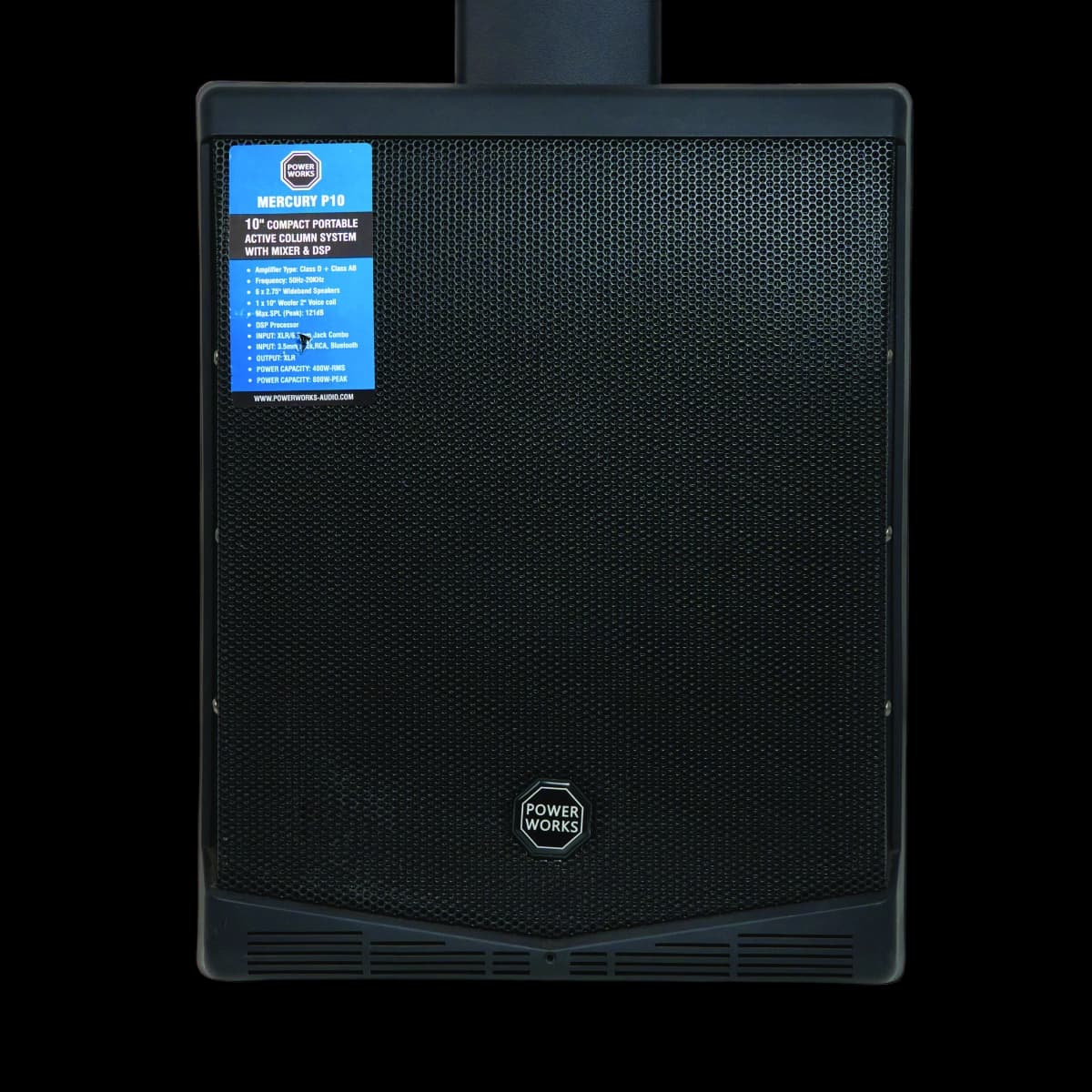
Somebody phones the shop most weeks with a version of the same question. We need speakers for our church hall. How many watts do we need?
It's a fair question. Watts is the number printed biggest on the box, so it's the number people reach for. The trouble is it's the least useful figure on the entire spec sheet when you're trying to work out whether a speaker will actually cover a room.
This article walks through what does matter, why, and how to do the sums yourself. It's the same method we use when we spec a system for a client, and there's nothing mysterious about it — it's arithmetic you can do on a phone calculator.
Why watts is the wrong number
Two reasons.
First, watts is an input, not an output. It tells you how much electrical power the amplifier can push into the driver. It says nothing about how much of that power gets converted into sound. That conversion job belongs to the driver, the horn and the cabinet, and different designs do it with wildly different efficiency.
You can have a 500 W speaker that plays louder than a 1000 W speaker. It happens constantly. A well-designed horn-loaded box with a high-efficiency driver will comfortably out-shout a cheap box with double the amplifier rating, because it wastes less of that power as heat in the voice coil.
Second, power scales badly against loudness. Doubling the power into a speaker gets you roughly 3 dB more output. That's it. Three decibels is a modest, clearly audible step — but it is nowhere near "twice as loud." To get a genuinely large jump you need ten times the power, not two.
Now flip that around. Sensitivity — how efficiently a speaker turns watts into sound pressure — is usually quoted in dB at one watt, one metre. If Speaker A is 3 dB more sensitive than Speaker B, Speaker A produces the same level on half the power. A 6 dB difference means a quarter of the power. Efficiency differences of several dB between well-designed and mediocre boxes are common — often worth more than the wattage difference between them.
So the wattage figure is doing far less work than the design of the box. Which is why we ignore it, and why you should too.
The number that does matter: maximum SPL
Sound pressure level, measured in decibels, at a stated distance. For an active (powered) speaker, manufacturers publish a maximum SPL figure — the loudest the box will go before it runs out of amplifier or driver. That figure is referenced to one metre in front of the cabinet.
One metre is the starting line. Everything else is worked out from there.
Two cautions before we do the sums, because this is where spec sheets get slippery:
- Continuous, program and peak are three different figures. Peak is always the biggest and always the most flattering. When you compare two speakers, compare like with like. A box quoting 130 dB peak is not necessarily louder than one quoting 124 dB continuous — you're reading two different measurements, and the peak figure typically sits 6 dB or more above the continuous figure for the same cabinet.
- Not every manufacturer measures honestly. Some figures are calculated from sensitivity plus amplifier power rather than measured on a real box, and some are measured against a wall (half-space), which flatters the number by up to 6 dB. Brands with a reputation to protect tend to publish figures you can rely on. Very cheap brands frequently don't.
The 6 dB rule
Here is the whole physics lesson in one line: sound loses 6 dB every time the distance doubles.
That's the inverse square law, and it applies to any conventional loudspeaker — a box radiating from what is effectively a single point. (Column arrays play by different rules; we'll come to those.) One metre to two metres is minus 6 dB. Two to four is another 6. Four to eight, another 6. Eight to sixteen, another 6.
So walk it out for a hall with eighteen metres from the speaker to the back row:
| Metres from speaker | Doublings | Level lost |
|---|---|---|
| 1 | — | 0 dB |
| 2 | 1 | −6 dB |
| 4 | 2 | −12 dB |
| 8 | 3 | −18 dB |
| 16 | 4 | −24 dB |
| 18 | 4.2 | −25 dB |
Four doublings gets you to sixteen metres and 24 dB of loss. Eighteen is a whisker further, so call it 25 dB.
If you want the exact figure for any distance, it's 20 × log(distance in metres). Eighteen metres works out to 25.1 dB. Twenty metres is 26 dB. Thirty metres is 29.5 dB. The rule of thumb and the formula agree closely enough that you can do either.
Working it backwards
Now we turn the sum around, because we don't want to know what's lost — we want to know what the speaker needs to be capable of.
Step one: decide what level you want at the back row. For spoken word in a church or hall, a comfortable average is 75 to 85 dB at the listener. That's a preacher who's clearly audible without being shouted at. Music pushes higher.
Step two: add the loss back on.
85 dB at the back row + 25 dB lost over eighteen metres = 110 dB required at one metre
Step three: add headroom. This is the step people skip, and it's the one that ruins systems.
Speech is not a steady tone. It has sharp peaks well above its long-term average — a consonant, a raised voice, someone stepping too close to the mic. Those peaks run 10 to 12 dB above the average level. If your speaker can only just manage the average, every peak clips.
A speaker run at its limit does not simply refuse to go louder. It distorts, and distortion in the vocal range is exactly what makes a system sound harsh and tiring. Push it long enough and you cook the voice coil — which is how a fair share of the drivers on our workshop bench arrive here.
110 dB + 12 dB headroom = 122 dB maximum SPL
So for an eighteen-metre room, you filter the catalogue for boxes rated 120 dB and up, and you stop looking at anything below that no matter what its wattage says.
That's the level half of the problem solved. Now the shape.
Coverage: a speaker throws a cone, not a sphere
A loudspeaker doesn't radiate equally in all directions. It projects into a cone, and the width of that cone is published as two angles — horizontal × vertical. A common pattern on a portable box is 90° × 60°.
(Technically, the quoted angle is where the level has dropped 6 dB off-axis. Outside the cone the sound doesn't stop; it just falls away quickly and loses its high frequencies first, which is why off-axis seats sound dull as well as quiet.)
Match the horizontal angle to the width of your seating.
Take a hall that's nine metres wide and eighteen metres deep. Point a 90° horn down that room and a large share of its output never reaches a listener — it hits the side walls, bounces, and arrives at the congregation a fraction of a second after the direct sound. Your ear can't separate the two. What it hears is a smear, and smeared speech is hard to follow even when it's plenty loud enough.
For a deep, narrow room you want something tighter. 60° to 75° horizontal keeps the energy on the seats and off the walls.
The everyday version, which is worth using on a client: it's a floodlight versus a spotlight. Same bulb, same power. One lights the whole yard dimly and the other puts a bright disc exactly where you're looking. For a long narrow room you want the spotlight.
Vertical is a separate question, and it's usually oversupplied.
Say the cabinet sits with its horn about 1.3 m above ear height. To cover a listener at 3 m, you're aiming roughly 23° below horizontal. To reach the back row at 18 m, about 4°. So the seating occupies less than twenty degrees of vertical spread — and a 60° vertical pattern is throwing most of its energy at the ceiling and the floor in front of the first row.
That excess is not free. It's the energy that comes back as reverberation. A tighter vertical pattern, aimed properly down at the seats, is one of the biggest intelligibility wins available in a hard room, and it costs nothing to get right at installation.
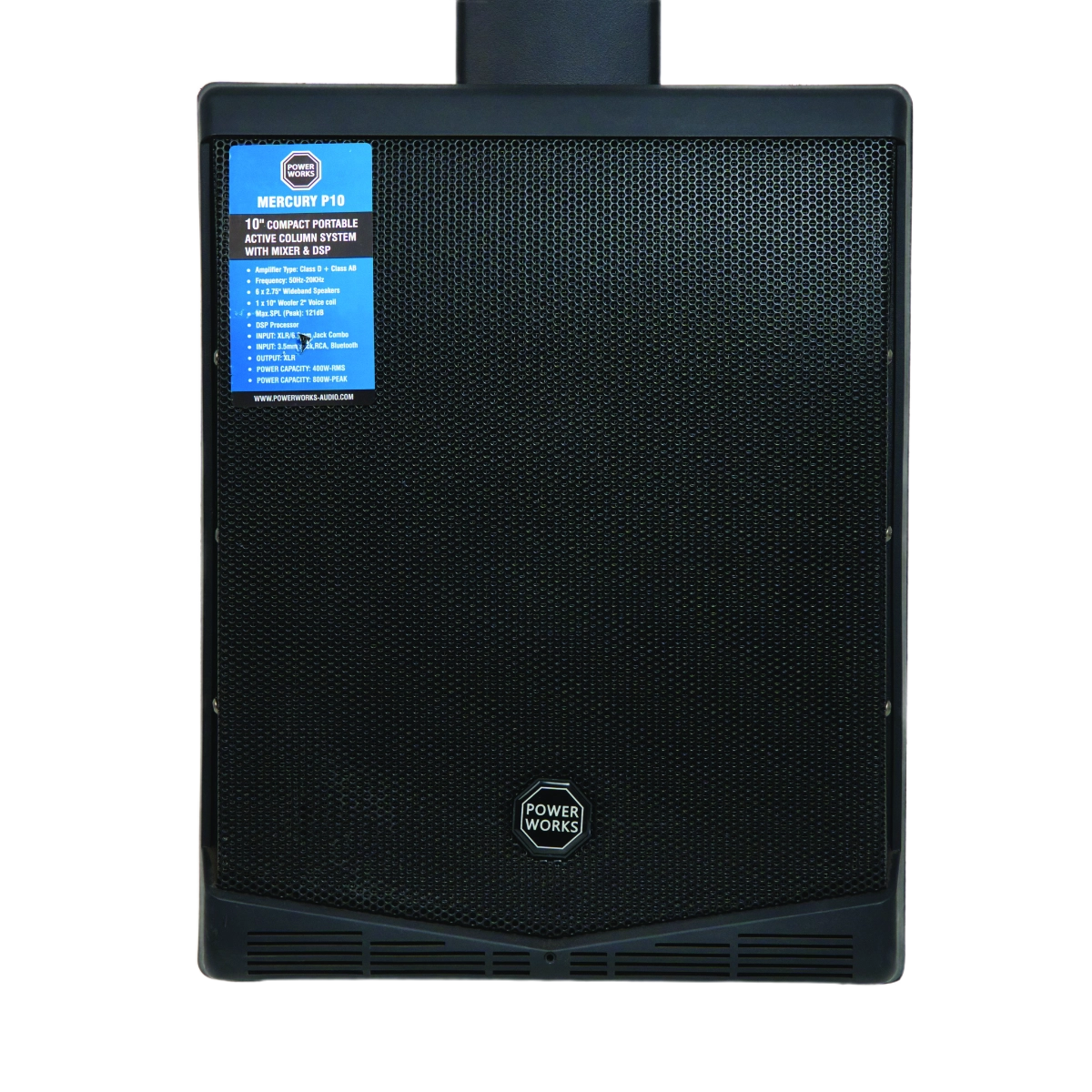
This is precisely the problem column arrays are built to solve: very wide horizontally, very tight vertically. And they carry a second advantage the spec sheet hides. A column of drivers behaves as a line source rather than a point source, and within its near field it loses roughly 3 dB per doubling of distance instead of 6. How far that near field extends depends on the column's length and the frequency — longer columns hold the behaviour further — but the practical effect is that a column keeps its level up down the length of a room far better than the inverse square law predicts.
Which means two things. The 6 dB sums earlier in this article are the worst case, and they apply as written to conventional boxes. And a column whose one-metre figure looks modest next to a conventional cabinet can still deliver more level at the back row — while putting less energy into the ceiling on the way. In a long narrow hall with a hard ceiling, a column will very often outperform a conventional box that measures better on paper. This is why, not marketing.
What the room does to your sums
The 6 dB rule describes sound travelling outward without obstruction. A real room adds a second thing: reflected energy that arrives after the direct sound.
Close to the speaker, direct sound dominates and the 6 dB rule holds. Further back, reflections build up and total level stops falling as fast. That sounds like good news. It isn't. What you gain in level, you lose in clarity — the sound arriving at the back row is increasingly not the sound the speaker aimed there. The words go mushy.
The practical consequences:
Hard surfaces make everything worse. Plaster, face brick, tile, glass and a timber ceiling all reflect efficiently. Carpet, curtains, upholstered seating and — significantly — a full congregation absorb. A church that sounds workable half full can turn difficult when it's empty, and a bare hall that measured fine on a Tuesday afternoon can behave very differently on a Sunday.
Which is why coverage angle matters more in a hard room than a soft one. In a carpeted, curtained space you can get away with a wider pattern. In a hard, narrow room you cannot.
Ceiling height sets what's possible. To cover the back of a long room, the speaker needs to be high enough to see over the heads in front. Under about three metres of ceiling, you often can't get the box high enough to throw cleanly to eighteen metres — the front rows block it and the pattern grazes across the audience, where it gets absorbed row by row.
When that's the case, the answer isn't a bigger speaker. It's delay speakers: smaller boxes placed part-way down the room, electronically delayed so their sound arrives fractionally after the mains. Your ear then still localises the sound to the front of the room, but the back rows get clean, close-range coverage. Done properly it's the single most effective fix for a long low hall, and it usually costs less than chasing the same result with brute force at the front.
Two speakers or four?
For eighteen metres, two is normally the right answer. A capable pair will reach.
It's tempting to think four boxes across the front must be better. Usually it's worse. Every place where two speakers' patterns overlap, their sound arrives via slightly different path lengths and combines unevenly — some frequencies reinforce, others cancel. You get comb filtering, which is heard as an uneven, phasey, hollow quality that shifts as you move. In a narrow hard room, more overlap makes the mush worse, not better.
Nor should you assume two speakers give you 6 dB more than one. They only sum that cleanly if they're effectively at the same point. Spread them left and right across a stage and, at most seats, you're predominantly hearing the nearer box with the other arriving late and off-axis. Design for what one box delivers to the furthest seat, and treat any summation as a bonus.
The reasons to go to four are coverage geometry — a very wide room, or a balcony, or a transept — not level. If you need more level, the answer is a more capable pair, or delays.
The checklist
When we spec a system, this is the order we work in:
- Measure the throw. Speaker position to the furthest listener, in metres.
- Measure the seating width. At the widest point.
- Note the ceiling height and whether there's a balcony or a low soffit.
- Note the finishes. Hard or soft. Carpet, curtains, upholstery — or plaster, tile and glass.
- Set the target level. 75–85 dB average for speech; higher for music.
- Calculate required SPL at 1 m. Target level + 6 dB per doubling of distance.
- Add 10–12 dB headroom.
- Filter by maximum SPL first, comparing like-for-like figures.
- Then filter by horizontal dispersion, matched to the seating width.
- Then check vertical dispersion and mounting height — can it be aimed at the seats rather than the ceiling?
Wattage doesn't appear anywhere in that list. It's a consequence of the design, not an input to the decision.
Two measurements is all we need
How far is it from the front to the back row, and how wide is the seating? Tell us those, plus roughly what the ceiling and walls are made of, and we'll tell you what class of speaker the room needs and what won't work. We stock across the range — from compact portable systems through to column arrays and full installed rigs — and we'd rather steer you to the right box than the expensive one.